Digital Mindfulness

More and more, people these days are becoming increasingly attached to their mobile devices. Recent research suggests that the average mobile phone user, which makes up a majority of people in society today, spends almost three hours per day looking at their phones! Is this a good thing? Well, there are many ways one can look at these staggering numbers.

Check out some mind-blowing statistics provided by the United Kingdom’s Telegraph.

https://www.telegraph.co.uk/news/2018/08/01/decade-smartphones-now-spend-entire-day-every-week-online/

Let’s take a look at what exactly digital mindfulness is.

The definition of digital is involving or relating to the use of computer technology. Mindfulness, by definition, is a mental state achieved by focusing one’s awareness on the present moment, while calmly acknowledging and accepting one’s feelings, thoughts, and bodily sensations.

Digital mindfulness, therefore, is being completely aware of oneself while utilizing technology.

Being digitally mindful can reap all sorts of benefits to those who practice it. What would be the largest benefit? It would be to truly find out how much influence technology has on your daily life.

Technology can be used as a source to improve daily activities. It can also be an expansive means of distraction for its users. Finding a healthy balance between the virtual world and the real world is critical to living out a better life!

Do I use technology mindfully? I would say that I do at times, and other times, I do not. The older I get, the more and more I realize how valuable life is and how essential it can be to stay present. It is all too easy to get wrapped up in the endless sea of information that the internet provides! Taking a step back and realizing where you are putting your time and energy should be done frequently. There is so much that we could be missing out on!

I did not download the Moment application on my phone, however, I took a look at its description. I think that it is a great source to actually see how much we use our phones. A lot of times, people are surprised to see the actual numbers of their mobile phone usage! The challenges and information it provides is also a great way to reclaim your real-world presence.

https://inthemoment.io/

Concentration and multi-tasking is also a major issue associated with the use of mobile phones. Daily tasks such as homework, career projects, workouts, reading, writing, and self-care can take twice as long to do perform subpar work! Unplugging from devices while carrying out daily activities might be the best way to go. Not only will it take less time to complete them, but the quality of work done will drastically improve because 100% concentration is going into the task at hand!

My eyes were opened exceedingly for this week’s digital mindfulness assignment. The amount of people who own mobile devices is increasing rapidly, and the time spent on those devices is becoming staggering!

Knowing just how much time and energy we put into these technologies is very necessary. We, as a people, should want to disconnect from the endless expanse of online distractions, and reconnect to the world that is happening around us!

Who Is an Activist?

“Who is an activist,” you might ask. Well let’s take a look at a few definitions to get us started off.

The definition of activism is the policy or action of using vigorous campaigning to bring about political or social change.

An activist, then, is a person who campaigns to bring about that political or social change.

Synonyms include, but are not limited to, protestors, zealots, radicals, or extremists.

Digital activism, therefore, is a type of activism that utilizes the internet and other forms of digital media as platforms for mass mobilization and political action. Social media, e-mail, mobile phones, videos, and podcasts are some of the most common modes of digital activism!

https://en.reset.org/knowledge/digital-and-online-activism

In doing this week’s assignment on digital activism, my eyes have been opened to things I’ve never really thought about! Some of the key points discussed within the articles provided are points that I have known about, but never truly taken a look at. It is mind-blowing to see how much of an impact we truly have in the digital world with just one click of a button!

Teens nowadays are all over social media. Whether or not they use their platforms for positive social influence is entirely up to the individual. The potential that the younger generation has to bring about social and political change is staggering! It is much higher than that of previous generations, where kids did not have as much of a voice!

This type of newfound activism can prove to be highly effective. It is possible that one Facebook status, Tweet, Instagram post, or YouTube video is moments away from becoming recognized by places all over the world! Again, whether or not these actions promote positive social or political change is ultimately up to the user.

Personally, I aspire to keep my social media persona positive, reflecting my core values and beliefs. It is all too easy nowadays for anyone to get their hands on any type of information that you provide to the world online!

Some key issues that we all need to consider as digital activists fall within social and political realms. Racism, sexual harassment, bullying, domestic violence, mental illnesses, and physical health are all excellent examples of matters we should be taking into our own hands digitally!

There are a few questions that I like to ask myself when it comes to my personal digital activism. What is the purpose of what I am posting? Does it help to further positive social and political reformation? Who will be able to view this material? What are the potential results from my posts? Who does this material effect? Is the information provided appropriate for all audiences?

Everyone can always improve their effectiveness when it comes to being an activist!

https://www.washington.edu/news/2013/11/20/study-shines-light-on-what-makes-digital-activism-effective/

Overall, what I found most interesting about this assignment was how much of an actual impact our online activity can be! It is pivotal that, as digital activists, we are seeking to always help improve the world that we live in!

ILP Week 10: NCAA’s

NCAA Division I Wrestling National Championship Reflection

Bo Nickal after winning his third NCAA title.
View this post on Instagram

I am so blessed.

A post shared by Jason Nolf (@jasonnolf) on

Jason Nolf after winning his individual title.

For this week in my independent learning project, I decided to postpone my series on the Holy Trinity to reflect upon the 2019 NCAA Wrestling National Championship! Since this is basically like a second Christmas for me, I really wanted to take some time to give some thought towards this year’s national tournament!

My heart pounds in excitement a day later, after the whole event is said and done. Countless things took place during the final tournament of the year, but I will narrow it down to those that involve spirituality!

Even though there are dozens of wrestlers within the national tournament this year that are solid men in their faith, two wrestlers will always come to mind when I look back at the 2018-2019 season. Not only are they true warriors of God, but they also happen to be two of the best wrestlers in NCAA history. Their names? Bo Nickal and Jason Nolf.

Nolf and Nickal are synonymous with entertainment. Their level of wrestling is so stellar that they make college wrestling fun to watch! A majority of their matches within their career end in either pins or scores of points put on the board. What is the best part, in my opinion? Not only are they inspirational role models, but also men that are sound in their faith!

In almost every interview that took place within their careers, they were never afraid to bring up how grateful they are to be blessed with the opportunities that they are given! It is very apparent that they put their trust in their Lord and Savior, Jesus Christ! Jason and Bo have used the platform that they have rightfully earned to impact the lives of many, both here and now and for eternity! They are phenomenal role models not only for wrestlers, but for all people of virtue!

Here is an interview of Jason Nolf just seconds after he earned his third NCAA national title! What he believes in is extremely evident in the answers that he gives!

Both Bo Nickal and Jason Nolf come together to take part in another interview after their individual and team titles. The two’s poise and confidence in who they are and what they believe in are manifest in what they say!

I am immensely grateful to be able to witness history and watch these two wrestlers cap off an incredible career. What is even better is that these two will continue wrestling on the international level, so we can all watch them take on the world!

It is men like these who I aspire to be. Who they are and what they stand for is sending waves of impact into the lives of countless people! More and more, we are seeing top tier wrestlers claiming to cling to their faith. I could not be any more pleased to see this!

Digital Citizenship

What is digital citizenship? This question is becoming increasingly important as our society is becoming more and more dependent upon technology and internet usage!

The definition of citizenship is the position or status of being a citizen of a particular country or state. The definition of digital is involving or relating to the use of computer technology. By somewhat combining these two definitions together, you can get digital citizenship!

So, the definition of digital citizenship, as provided by teachthought.com, is “the quality of habits, actions, and consumption patterns that impact the ecology of digital content and communities.”

https://www.teachthought.com/the-future-of-learning/the-definition-of-digital-citzenship/

Another, more simple definition that I like is provided by a website dedicated to digital citizenship. It states that digital citizenship is “the norms of appropriate, responsible technology use.”

http://www.digitalcitizenship.net/

One major question surfaces when talking about this term. How should we act when we are online?

More and more, people all around the world are interacting digitally with each other. The way in which we interact with our online content, each other, and various communities is largely important! We must always keep in check the quality of our activity, habits, and consumption of materials!

It is all too easy nowadays to sit behind a computer screen and say and do whatever we want to! This should not be the case.

If you take some time to look into it, the digital footprints that we leave behind can be surprisingly detailed! Any person, from all over the world, can search your name and discover who you are and your identity online!

It is our responsibility to behave whilst online and contribute to the common good of our digital communities! Being helpful and respectful are two of the largest components of digital citizenship.

Teachthought.com also gives some terrific examples of what it might look like to be an effective digital citizen! They state that communicating with respect, respecting other’s privacy, seeing things from other perspectives, contributing helpful information to a discussion, supporting others, providing constructive feedback, encouragement, and sharing useful content are all ways in which we can enact digital citizenship!

Our online identity and how we interact digitally is becoming increasingly important within this age of technology. Keeping our activities, habits, and consumption in check is highly important! Not only do we want to make sure our online identity is in good shape, but also the internet as a whole! Educating the world about digital citizenship is essential!

Who are you online?

Believe it or not, googling myself for this assignment is not the first time that I have done so! In the past couple of years, there are a number of times where I have been curious as to what would happen if I searched myself online!

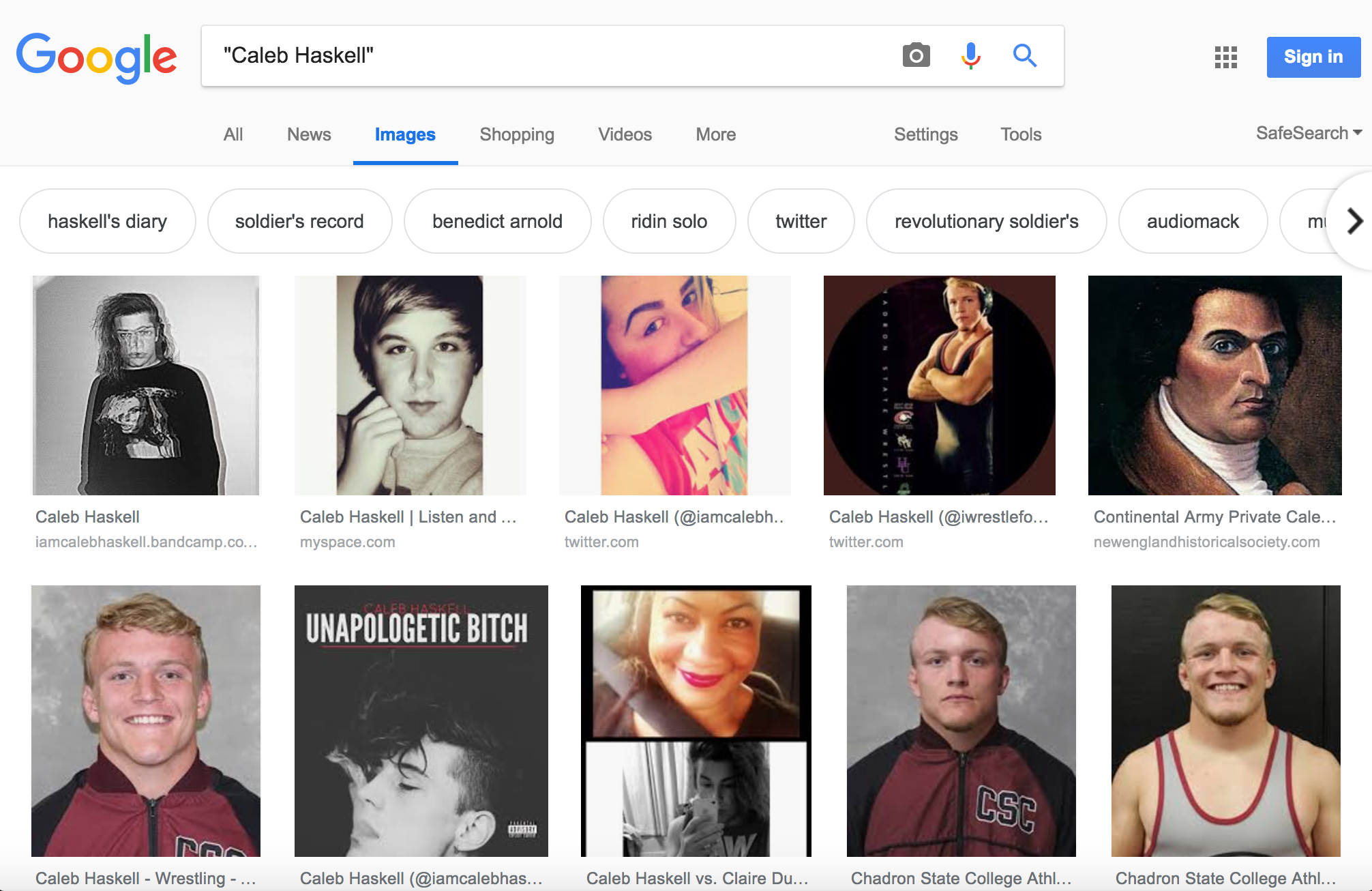
There are two common themes that surface if one types the name of “Caleb Haskell” into the search bar. The first one being wrestling. As it turns out, a large part of my high school and collegiate wrestling career can be found online! A number of different photos, videos, news stories, and posts from social media pop up about my wrestling! Dedicating some time to actually look at what is out there has blown my mind! There is a lot more than I originally thought!

The other common theme that pops up is something entirely different. I guess there was another, more famous Caleb Haskell that lived long before me. He was a Revolutionary War veteran who lived in the 1700’s! To save you some time and energy, I will not go into too much detail about this particular Caleb Haskell.

Putting my name in quotation marks resulted in very similar search results. When I typed in my middle name, however, I was surprised to find something else! Supposedly there is yet another Caleb Haskell out there that is low-profile singer and songwriter. Adding my middle name into the search bar actually makes it harder for me to find my actual self!

Other than finding myself in the media for wrestling, I would say that I am most active on my social media! Facebook, Twitter, and Instagram is where I spend a significant amount of time creating my online identity. My favorite mode of social media would have to be Instagram, and it is also where I probably spend most of my time.

I am fully aware that my peers, classmates, co-workers, professors, potential employers, and many others have access to view my social media accounts. For this main reason, I make sure that the content that I post is appropriate and for the good of whomever it might concern!

Most, if not all of the time, I make sure that my posts are not offensive, do not contain profanity, and are appropriate for all ages to view! Positive, inspiring, encouraging, informing, uplifting, and enlightening content is what I aspire to post regularly with my online persona!

It baffles me to see just how detailed our digital footprint is! We must take special care to make sure our online influence lines up with who we are and what we believe!     

ILP Week 9: Updates

With everything else that is due this week in our Literacy in the Digital Age class, I will just give a brief update on my independent learning project!

As I mentioned in my last ILP blog, I plan on devoting the next three weeks to studying the Holy Trinity. The first week will be dedicated to God the Father, the second week will focus on God the Son, and the third and final week will look at God the Holy Spirit!

Not only do I plan on looking into the Holy Trinity as a whole, but also how each Divine Person can be incorporated into sport!

In the meantime, here are three of my favorite FCA Wrestling testimonies from some of the biggest names in USA Wrestling!

World and Olympic Gold Medalist, Jordan Burroughs
USA Freestyle Wrestling Head Coach, Bill Zadick
Olympic Gold Medalist, Brandon Slay

Technology Proposal

            For the sake of my current and future students that take my high school math classes, I have a technology proposal that could improve academic success substantially! I am proposing that one of the latest versions of SMART Board be implemented into my classroom. With mathematics being so hands on and chalk boards becoming obsolete, SMART Boards have paved a way to implement old traditions with new technology! Some of the latest SMART Board versions, namely, the SMART Board 6000 Series, provide a large amount of aid within classrooms, especially those concerning math and science! Incorporating a SMART Board into my classrooms will help me to improve my teaching, upgrade my work efficiency, and enhance students’ learning experience!

Supplemental Assignment #2

Children under the age of three should not be allowed any screen time whatsoever.

Technology in this age is booming and it does not look like it is slowing down anytime soon. With these rapid technological advances, there are both pros and cons that are associated with them. Even though technology helps to improve our everyday lives, the misuse of it can prove to have harmful effects. Because of physical, social, and health problems, children under the age of three should not be allowed any screen time whatsoever. I will get things kicked off with the physical pitfalls of young children spending too much time behind a screen.

There are a number of different physical disadvantages when children spend too much time with their technology. Eye problems, postural issues, and excessive inactivity are among the largest problems, especially with younger children. Because these children are still developing, the issues at hand are magnified. Too much sedentary activity is one of the most concerning issues. Raisingchildren.net.au states that, “being inactive for long periods using a screen can lead to a less active lifestyle, which can lead to obesity.” According to the State of Obesity, as of 2018, a majority of U.S. states have obesity rates that exceed thirty percent. With alarming statistics as these, taking any kind of precaution would be most wise!

The social side effects of excessive screen time are concerning as well. Language development, social skills, and face-to-face interactions are all hampered with when children spend too much time behind a screen. An inability to hold conversations, maintain appropriate eye-contact, and read body language can all result from too much technology time, according to CNBC. Even though technology and social media can further communicational efforts, real human interaction is waning. Letting kids get out and experience everything the world has to offer is essential!

There is another major health issue that surfaces with the usage of technology. This issue is our subpar sleeping patterns. The light emitted from screens interferes with the sleep cycle in the brain and can lead to insomnia. (Morin, 2018) The Sleep Health Foundation states that the bright light from cell phones, tablets, personal computers, and televisions blocks the release of sleep hormones, particularly, melatonin. Sleep is vital for young children and their overall development. Taking unnecessary screens away from children under the age of three would be extremely advantageous.

Physical disadvantages, social side effects, and inhibited sleep patterns are all reasons why children three years old and younger should not see any screen time. With technology advancing ever so quickly, we must make sure we are paying attention to our children’s technological consumption. Taking advantage of the positives and being mindful of the negatives of this situation is paramount to our children’s overall well-being!

ILP Week 8: The Holy Trinity

Going over all of the ideas I that covered over the course of these first eight weeks, I reflected upon what I wanted to go over in these next couple of weeks. For the next four weeks, I am seeking to dive deep into who God says He is! This week, I will write about the Holy Trinity, and the following three weeks of blogging will include a focus on God the Father, God the Son, and God the Holy Spirit!

Not only do I want to learn more about the essence of our Lord, but also look into how I can incorporate Him into my sport! Let’s get things rolling!

God is known as three separate, yet unified persons in God the Father, God the Son, and God the Holy Spirit! It is a bit difficult to wrap our minds around, but Isaiah 55:9 helps us to understand that, “As far as the heavens are above the earth, so are My ways above your ways, and My thoughts above your thoughts!”

Trying to fully grasp and understand God is proves to be futile. Trusting in who He says that He is is the only way to go!

God the Father is regarded as the first person within the Holy Trinity. Like I mentioned before, assigning God a definition is quite foolish. There are, however, adjectives within the Bible that can describe Him! Loving, good, gracious, perfect, sovereign, eternal, omniscient, all-knowing, righteous, just, kind, forgiving, holy, infinite, omnipresent, divine, true, compassionate, mighty, strong, merciful, unchanging, powerful, faithful, and glorious are just a handful of attributes of our Lord Almighty mentioned within His Word!

Within sport, leaning into His strength, power, wisdom, love, truth, and perfection instead of our own would be most wise. Even though it can be difficult to rely upon something that we cannot see, it is one of most important things that a Christian athlete can do! For, “faith is the substance of things hoped for, the evidence of things unseen,” (Hebrews 11:1).

God’s will for our lives is good, pleasing, and perfect. We must trust that He will accomplish through us what is best for us within our sport as well as every other aspect of our lives here on earth!

Next up is God the Son, our Lord and Savior, Jesus Christ! Jesus came down from Heaven, lived a blameless life saturated with miracles, and was tortured and crucified for our sins! He then died, resurrected from the dead, currently sits at the right hand of the Father, and will come again in glory to judge both the living and the dead!

Jesus represents love, service, sacrifice, justification, redemption, perfection, revival, courage, boldness, strength, endurance, faith, hope, freedom, patience, kindness, goodness, humility, fellowship, generosity, purity, holiness, wisdom, compassion, diligence, obedience, determination, fearlessness, grace, mercy, prudence, understanding, virtue, selflessness, among many other countless attributes! Conforming to the image and likeness of Christ is one of the main things a Christian must do within their lives! Philippians 2:5 tells us to, “Make your attitudes that of Christ Jesus.”

Portraying the person of Jesus Christ within our sports will set us up for everything that God has in store for us! Reflecting who Christ is within the field of competition yields substantial benefits physically, mentally, emotionally, and spiritually!

Last up is the third person within the Holy Trinity, the Holy Spirit! The Holy Spirit is known to be our helper, teacher, advocate, revealer, counselor, comforter, intercessor, reminder, and guide! Once we believe and accept Jesus into our hearts as Lord and Savior, we are given His Spirit to dwell within us! He will empower us to help bring about the Lord’s kingdom!

The nine fruits of the Holy Spirit include love, joy, peace, patience, kindness, goodness, faithfulness, gentleness, and self-control (Galatians 5:22-23)! There is said to be seven gifts of the Spirit as well, which include wisdom, understanding, counsel, fortitude, knowledge, piety, and fear of the Lord (Isaiah 11:2-4)!

Acknowledging the Holy Spirit’s presence, being in-tune with what He is trying to tell you, and walking with Him step for step will help prepare us for everything that life throws our way! Relying upon the power that the Spirit gives to us will also help substantially within the context of our sport!

The concept of who God is blows my mind. Recognizing and putting full trust within God our Father, God the Son, and God the Holy Spirit is the only way we can live our lives to fully please the Lord!

Learning Approach: Personalized Learning

For this week in learning approaches, I decided to take an in-depth look at personalized learning. Since I plan on becoming a teacher in the near future, I wanted to choose a learning approach that I thought would benefit me the most! Personalized learning takes a look at the specific ways in which students learn so that teachers can implement them within schools to maximize academic success!

The official definition of personalized learning from the U.S. Department of Education is “instruction in which the pace of learning and the instructional approach are optimized for the needs of each learner. Learning objectives, instructional approaches, and content all may vary based on learner needs. In addition, learning activities are meaningful and relevant to learners, driven by their interests, and often self-initiated.”

Here is a Youtube video that also gives a good description of the practice of personalized learning!

There are a number of different ways in which a student can learn, and finding and incorporating those modalities can prove to be a difficult task! However, effectively utilizing personalized learning can bring about a lot more benefits as opposed to its costs!

What might a classroom look and sound like when a teacher uses this approach? Depending upon which specific route an educator chooses to take, a given classroom that incorporates personalized learning might look more inviting, visually appealing, and a tad bit crazy! Every student is different, and recognizing diversity in the classroom might make the environment a little more “eye-catching”!

A typical classroom that involves personalized learning could look something like this!

As far as sounds go, it could vary widely as well. Some classes might like it quiet so as to focus on the tasks at hand while others prefer engagement and hands-on activities! It all just depends on what suits that particular class the best!

With the personalized learning approach, it is difficult to distinguish what the students should typically be doing without taking a look at a specific class. This method involves differentiation, which means adjusting instruction to meet the individual needs of students. So as far as concrete guidelines go, personalized learning does not have much to offer. How time is spent, how classrooms are organized, and how the teachers educate their students all depends on the individual abilities, needs, and interests of those students!

There are a few disadvantages that are associated with this approach. The initial time and energy that it requires to build a solid personalized learning foundation is substantial. Finding and figuring out which ways each student learns most effectively can prove to be a daunting task! Then determining the specific methods of instruction that you want to incorporate into the classroom to get the most out of the students is the next challenge.

Once these steps are executed, and teachers gain more and more experience over time, personalized learning is proven to pay dividends. Our students should come first! Taking into consideration their wants, needs, talents, and interests should be at the top of our lists!

Three excellent accounts to follow on Twitter to learn and investigate more on personalized learning are @PeteSiner,@allison_zmuda, and @SPPS_PL!

For more quality information on this topic, take a look at the website below! It provides an in-depth look at what personalized learning is, how it works, and how to apply it into our classrooms!

https://www.edelements.com/personalized-learning